
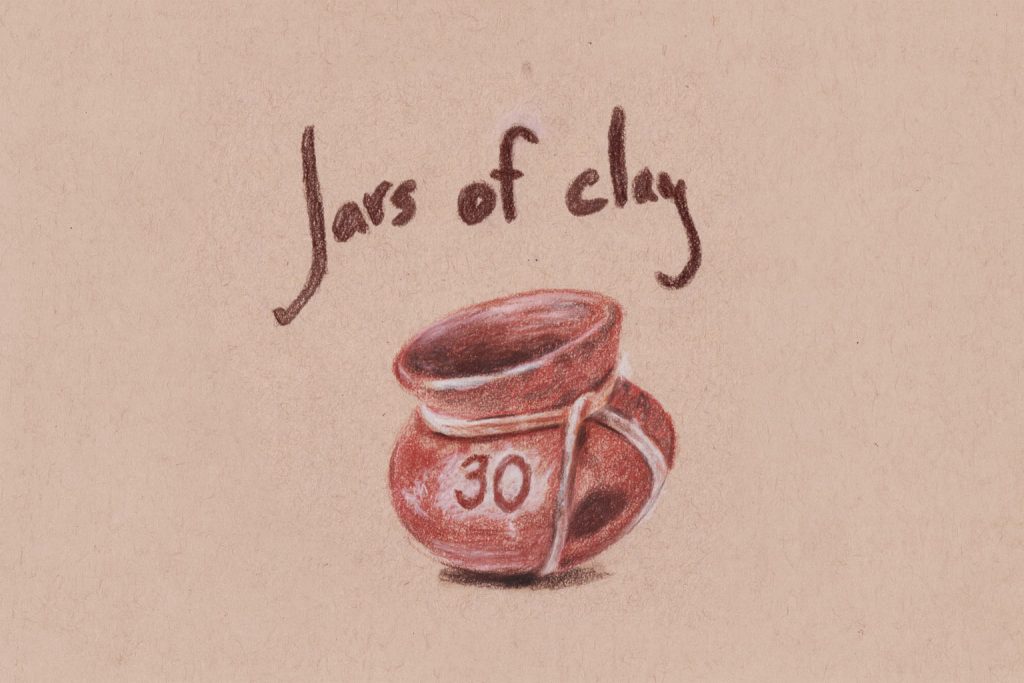
JARS OF CLAY 30 — Celebrating 30 Years of Their Self-Titled Debut Album
THE HISTORY:
Have you ever walked by someone you didn’t know, who happened to be wearing the shirt of a band you particularly liked, and used that band as an opportunity to greet them? For music lovers, a shared affinity for a beloved artist is often the only bridge necessary to establish a first meaningful connection. For Steve Mason, Charlie Lowell, and Dan Haseltine, a Toad the Wet Sprocket t-shirt was the impetus for introducing three underclassmen living on the same floor at Greenville College, the storied Illinois faith-based liberal arts school. Thirty years later, those original shirt-inspired meetings have given us the legacy of one of the all-time great Christian alternative bands.
Music was a passion for the three—Stephen and Charlie were both studying in the music program at Greenville—and the shared passions quickly led to the formation of an actual band, with the addition of Matt Bronlewee, a fellow Greenville music student. The foursome cut a demo in the Greenville College studios to submit to the Gospel Music Association Spotlight talent competition in April 1994. Of course, you can’t submit a demo without an actual band name, and so with inspiration from 2 Corinthians 4:7, Jars of Clay—a name that Charlie once credited to the band’s first manager Troy VanLiere—was officially born.
Much to the band’s surprise, they prevailed in the Spotlight contest (reportedly against over 200 other unsigned bands), and suddenly Jars of Clay was given quite the push into serious music making. By all accounts, the three-song demo that the band created and submitted to GMA Spotlight had an electronic edge that leaned somewhat into the band’s other stated influences of Depeche Mode and Pet Shop Boys. But post-competition, a quick pivot was made to focus squarely on the acoustic-driven folk influence of bands like the aforementioned Toad the Wet Sprocket. In seemingly no time at all, the foursome and their new acoustic direction would wrap up production on the band’s first real demo, Frail. That demo, with a total of 1,500 copies pressed, featured early versions of six songs that would end up on the self-titled debut, as well as the instrumental title track (written by Steve Mason as his college entrance project) and later standout “Fade to Grey.”
It was full-steam ahead for Jars of Clay as GMA distributed their demo to record labels and the members left school and relocated to Nashville—well, almost all the members; Matt Bronlewee, newly married at age 20, decided that his path was to remain in college, so he stayed behind at Greenville. He is credited as co-writer on six of the songs on Jars of Clay (the liner notes credit him as “arranged with”), and some of his playing on “He” was used on the debut. He would later go on to work with Plumb, Chris Tomlin, and Rebecca St. James, as well as form The Hawk in Paris, an excellent side project with Dan Haseltine. To take Bronlewee’s place as second guitarist, Charlie recruited Matt Odmark, his childhood friend from Rochester, New York, and the lineup that would endure 30+ years was solidified.
After interviewing with multiple Christian labels—all of whom were extremely eager to sign this upstart band, representing an acoustic sound that had no current parallels in Christian alternative—Jars settled on Essential Records. Essential was the smallest label they interviewed with, which was perfect for the band because, as Steve Mason put it, “There was more of a family atmosphere, and we felt more of a common vision in ministry.” The recording contract was now signed and any thoughts of going back to school were far in the rear-view. Work on their first real album began in earnest during late 1994, with 21-year-old Dan Haseltine the senior member of the group. Though the band members fled college before any completed more than two years, they would later receive honorary degrees from Greenville College in 2001—including Matt Odmark, who never actually attended there.
THE ALBUM:
Whether it was self-confidence beyond their years, or simply a lack of funds (hard to totally believe, given the album’s lengthy credits—more on that later), Essential allowed the band to self-produce almost their entire self-titled debut album. The resulting album sounds thoughtful, at times playful and energetic, and at times melancholy and reflective, introducing the distinctive voice of Dan Haseltine, who could tenderly carry a ballad like “Art in Me” just as well as the up-tempo “Boy on a String,” while adding just a hint of 90s vocal gravel to “Love Song for a Savior.” His lyrics displayed maturity and sincerity, most notably on the beautiful “Worlds Apart” and the often-overlooked “Sinking”—always emphatically Christ-centered in content, whether through clever biblical metaphors or the simple refrain I want to fall in love with You from “Love Song for a Savior.”
The self-production brings forth two very important elements of the Jars’ debut sound: a distinctive acoustic strumming pattern (you probably know this already if you’re reading this, but there are no electric guitars present on the album)—and the unique alternate tuning that, to date, Google searches do not associate with any album other than Jars of Clay. For guitarists: drop the D string to B, and drop the G string to E, and you’ve got EABEBE, the foundation for almost every song on the album. Now put a capo on the third fret and play, relative to the capo, 505050 (CCGGGG), and you’ll recognize one of the most famous Christian song intros of all time. That unique tuning provides a notable resonance, often amplified by the playing of 12-string guitars with that unmistakable strum pattern. Barely three months after the release of the single “Jesus Freak” (August 1995) put distorted alternative rock directly in the forefront of Christian music, here was the counterpoint: acoustic guitars can sound really cool too. (Jesus Freak the album was released in November 1995, just four weeks after Jars of Clay.)
Though almost the entire album features programmed drum loops—studio drummer Tim Smith played drums on “Flood” and still lists that as a front-page achievement on his website—the most distinctive element of the entire album is the incredible beauty of the strings. Other than the core four members, there are a remarkable 11 additional musicians who contribute various instruments, most of the stringed variety, and many of the earworm hooks of the album rely on these guests. In fact, “He” is the only song on the album without a guest string performer. Imagine “Liquid” without the violin harmonies, or “Like a Child” or “Boy on a String” without Jonathan Yudkin’s delightful fiddling. The emotional impact of the album closer “Blind” is so much stronger with the foreboding chorus strings. And of course, you know that one really popular song and its memorable bridge string passage.
The two notable exceptions to the band’s self-production are the more energetic rock-leaning tracks, the brilliant opener “Liquid” and the eighth track “Flood.” As the story goes, Essential Records had an intern whose uncle happened to be Adrian Belew, the legendary progressive guitar icon from King Crimson, Frank Zappa, David Bowie, etc.—certainly with no previous connection to the Christian music industry. Belew was curious enough to agree to produce two songs for the album, and the band decided those two were the best options. Belew plays the iconic mandolin and bass parts for “Liquid” and the cello in “Flood,” and certainly deserves a lot of the credit for shaping the sound that led to many secular radio stations picking up “Flood” in the first half of 1996. No one can exactly point to the first station that played the song; it was more like a very gentle wave that slowly cascaded across the country until the song was squarely in the top 10 on secular alt-rock stations everywhere—almost nine full months after the album’s release. In those days, a hit radio single directly correlated to CD sales, and Essential’s sister label Silvertone Records quickly began distributing the album in secular outlets. Jars of Clay was present on the Billboard 200 album sales chart for all 52 weeks of 1996, and to date has sold over three million copies worldwide—a substantial majority of which can be squarely tied to the “Flood” of success in 1996.
Of course, the success of a song like that, which isn’t perfectly representative of a band’s sound or direction, is a mixed blessing. I personally attended Jesus Northwest in July 1996 where Jars had the 2:00 main stage slot—not exactly the headliner, as the festival schedule was set many months before—and the attendance at first was overwhelming, far more than the previous night’s actual headliner. Except, of course, Jars didn’t really have much that rocked live in the way “Flood” fans were looking for, and disappointed and bored listeners steadily made their way toward the exit until the band finally transitioned from “Fade to Grey” into their hit single to close the set. It was unfortunate to see a band with a sound perfect for an intimate coffeehouse forced by their success to fit into the model of a large festival band. (For those historically curious, that show featured a performance of Petra’s “Rose Colored Stained Glass Windows” that Dan identified as the first time the band had ever played an electric guitar on stage.)
You can have your “Flood” if that’s your JOC point of connection—while the acoustic rock sound was notable and catchy and the perfect thing for that mid-90s moment, in this writer’s humble opinion the band never again reached the achievement of “Art in Me,” the exceptionally beautiful fifth track with prominent piano by Lowell and an incredibly moving five-piece string section arranged by Ronn Huff. With Haseltine’s tender delivery and brilliant lyrical maturity, the gentle percussion, and perfect string bed, it is the apex moment of a debut brimming with more confidence than one could have reasonably expected from four college-age kids.
THE LEGACY:
Much like many great debut albums made without the weight of expectations (The Legend of Chin, Weezer’s Blue Album, etc.), Jars could do whatever they wanted with their debut, and they sure did—but it’s not quite so easy with a follow-up, and very few sophomore albums carried with them the burden of what would become Much Afraid. The sophomore album, released in 1997 on Essential, took the wholly original acoustic sound and turned it toward much more of a light Top 40 radio sound with the hope of escalating mainstream success. The band even wrote a song specifically to play during the closing credits of the Jim Carrey movie Liar Liar, which was cut in favor of an outtakes reel (the song, “Five Candles,” was later used in the movie Jack Frost).
Gone was the unique and thick acoustic prominence; if there had been Reddit boards in April 1997, I wonder what the buzz would have been like when Adrian Belew made his sole Dove Awards appearance to introduce the band and their single “Crazy Times,” featuring Steve Mason playing an electric guitar—including a solo flourish using his teeth (the performance is available on YouTube). It’s a great song, but it also sounds very much like a band trying to shed a specific sound and gain more mainstream spotlight acceptance.
Much Afraid debuted at #8 on the Billboard charts and fell rapidly, and is not particularly well-remembered today—and that would be enough, for many bands, to begin a long fall as quickly as their meteoric rise. But free from both the unique pigeonhole of their debut and the major-label desperation of their follow-up, Jars of Clay’s third album If I Left the Zoo is a quirky and delightful soft rock album that finally brought the spotlight to the band’s songwriting rather than the album’s sound.
Since that 1999 release, Jars has had an extremely productive and prolific career, with a steady stream of stylistically diverse studio albums through the 2000s (their 2009 album The Long Fall Back to Earth, a fun 80s-inflected pop album, was the JFH #1 staff pick for that year). Many, this writer among them, would suggest that 2013’s brilliant Inland may have closed their career with their finest work. Since 2013, the band has lain low in “hibernation,” as Dan calls it, still occasionally reuniting for a Tennessee Christmas concert. Whether we will ever have new music from them seems less likely as more time passes, but anyone who was in this scene in the 1990s probably feels the same as me—in disbelief that it’s been 30 years since this unique masterpiece.
In early 2025, the JFH Podcast conducted a massive nostalgia March Madness tournament, pitting Christian albums from 1995, 2000, 2005, and 2015 against each other through public voting—and the result, much to the surprise of myself and many others who expected more modern bias to prevail, was a thorough and definitive victory for Jars of Clay. It’s a well-deserved triumph for a masterpiece of a self-assured debut that is among the most uniquely beautiful and important albums of its era—and maybe ever.
— Evan Dickens
Evan! This is so well done. Thank you for the depth and care you took in putting this together. Not sure I agree with you about Much Afraid though. 😉